
Industrial Powder Grinding Equipment
A pin mill is a high-speed impact mill that turns minerals, chemicals, pharmaceuticals, and food ingredients into uniform fine powder. Its adjustable pin discs let one machine hit many particle-size targets, which is why it shows up across food, pharma, chemical, and mineral plants.
What Is a Pin Mill
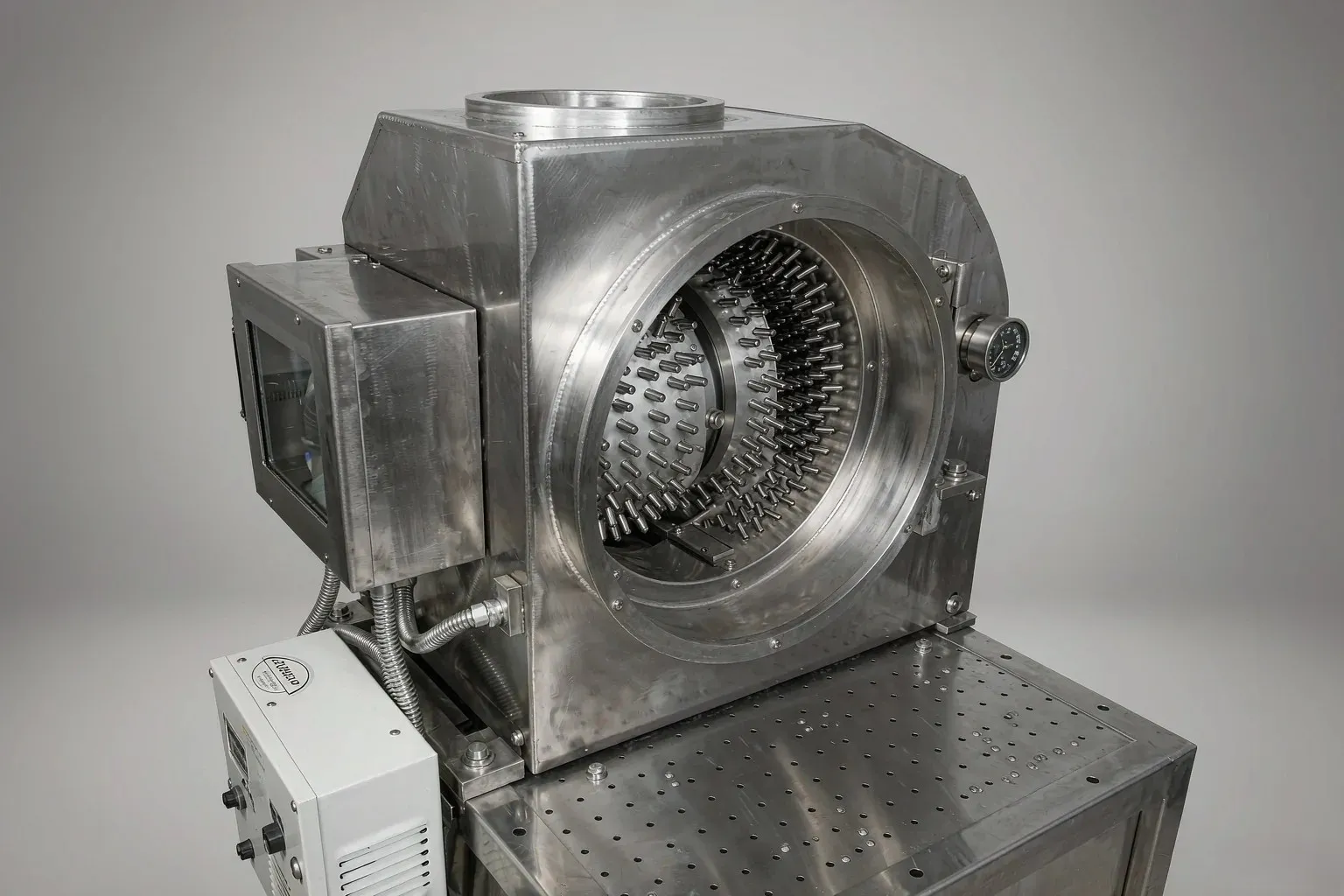
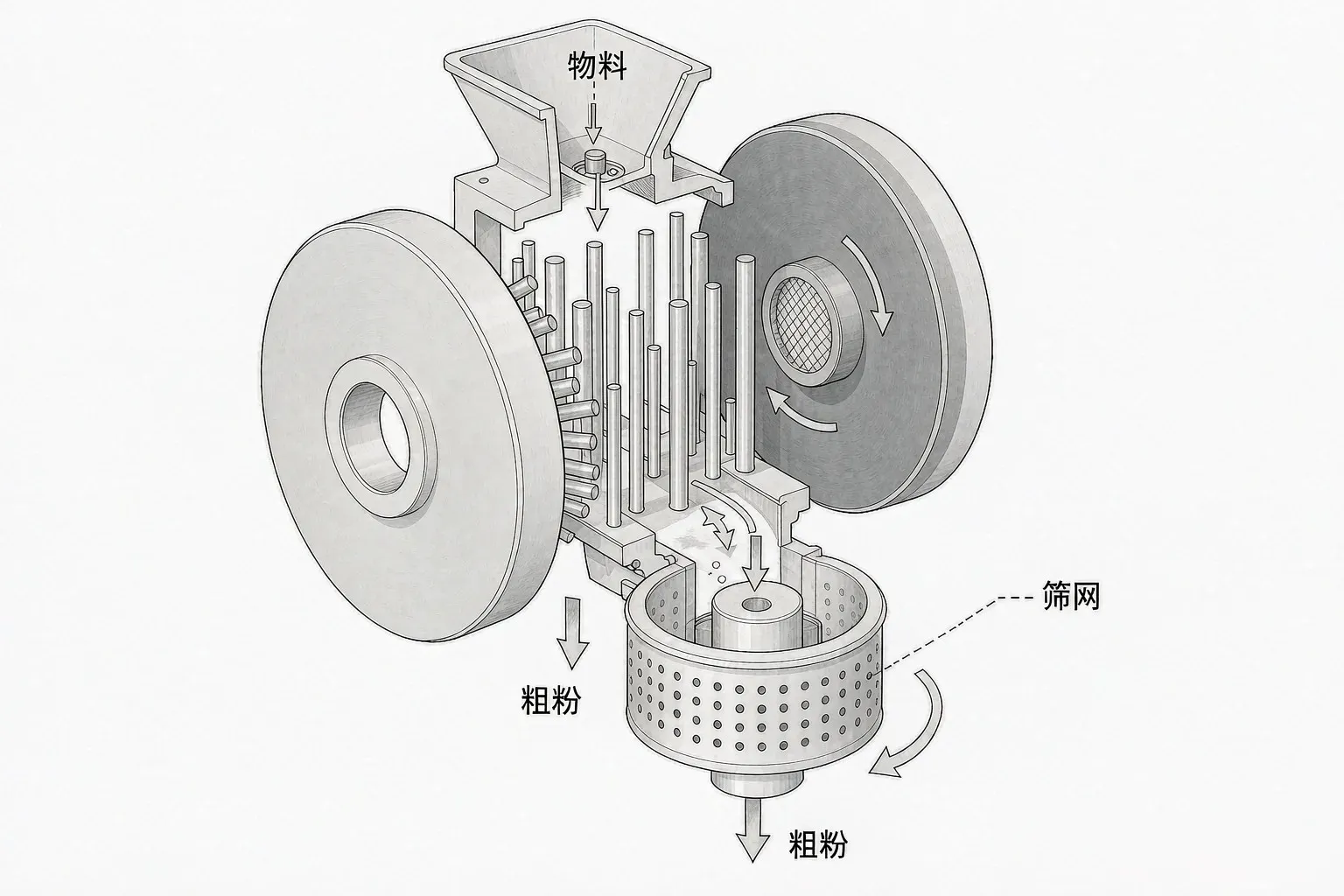
A pin mill — also called a pin disc mill or pin grinding machine — uses two high-speed rotating discs studded with interlocking pins to impact, shear, and shred material into fine powder or granules. The main parts are the feed inlet, the pin discs (one fixed, one rotating), the grinding chamber, a screen, and the discharge outlet. Raw material enters the feed inlet, passes through the fast-spinning pin rotors, and is continuously crushed, impacted, and sheared until it reaches the required size. Because particle size is controlled simply by adjusting rotor speed and pin arrangement, a single machine can serve many production needs.
How a Pin Mill Works
The grinding chamber is built around two parallel pin discs: a stationary disc and a high-speed rotating disc, both covered with pin projections. When material enters the chamber from the feed inlet, it first meets the shear zone between the rotating disc’s innermost pins and the fixed disc for the first crushing stage.
The material then moves through successive grinding zones, undergoing second and third stages of impact and shear, breaking down into finer particles. Ground powder is filtered through the screen; anything that passes the screen is finished product. Oversize particles keep circulating until they reach the target fineness. Finally, the finished powder exits through the screen and the discharge outlet, completing the cycle.
Pin Mill Applications
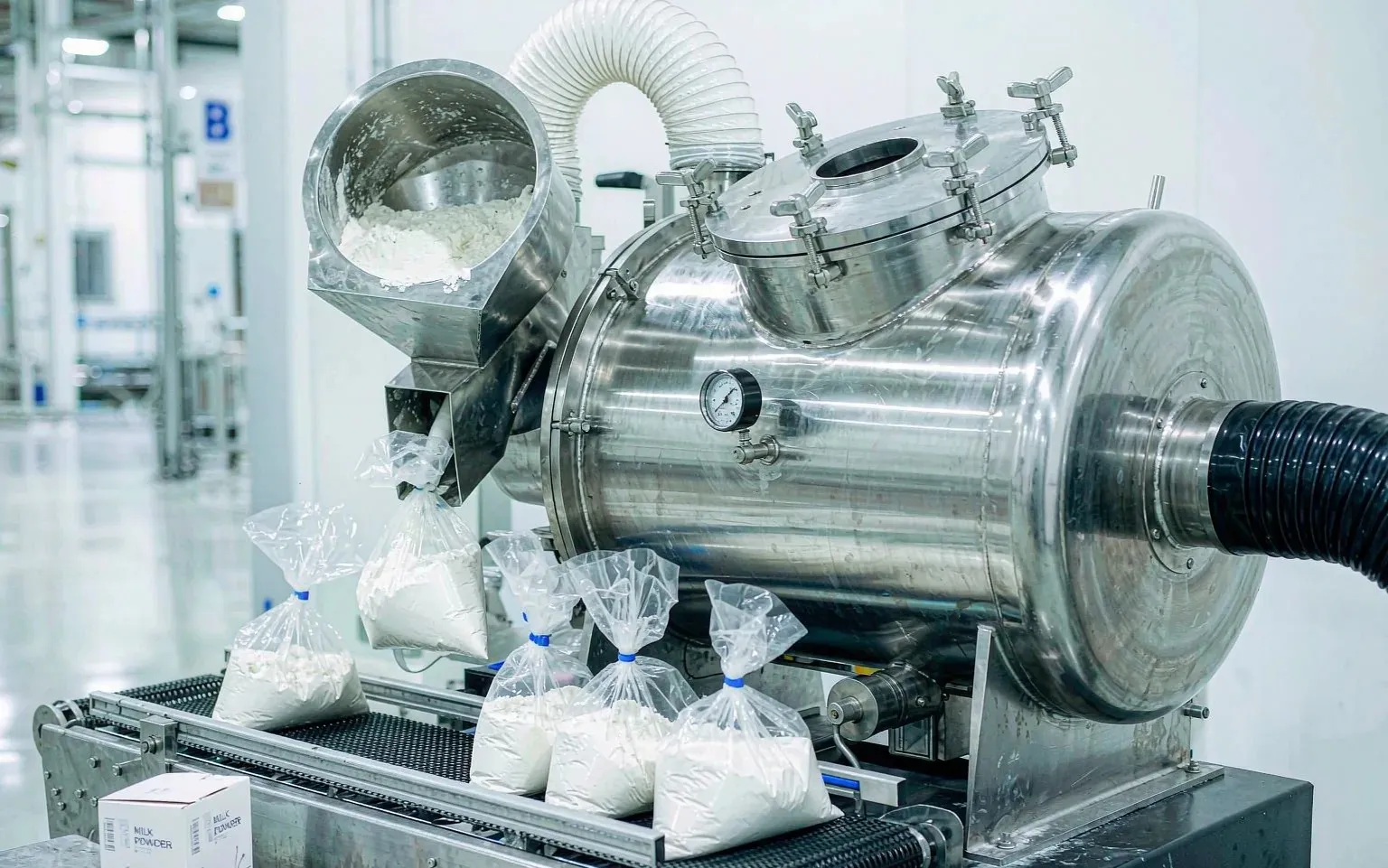
A pin mill serves six broad application areas:
1. Food industry
Pin mills are essential in food processing for grinding agricultural products such as potato flour, sugar, and coffee, plus spice blends. Adjustable pin discs control particle size precisely, improving appearance and quality while keeping batches consistent and meeting food-safety requirements.
2. Pharmaceutical industry
In pharma, pin mills grind active and excipient materials. The fine milling reaches micron-level particle sizes; smaller, more uniform particles dissolve faster and absorb better, improving drug efficacy.
3. Chemical industry
Pin mills pulverize pigments and chemical additives. Finer, more even particles make reactions more complete, colors more saturated, and solubility higher so powders blend into reagents faster and more stably.
4. Cosmetics industry
Cosmetics demand very fine powders. Pin mills grind titanium dioxide, talc, and pigments to grade, giving foundations and eyeshadows an even, smooth finish and a better user experience.
5. Plastics and polymers
Pin mills reduce resins and plastic feedstock to fine granules. Uniform particles mix more thoroughly, raising the toughness, strength, and durability of the final product.
6. Minerals and ore
In minerals, pin mills process graphite, limestone, and quartz sand. Adjustable pin spacing, pin design, and speed let operators customize particle size to each mineral’s hardness, raising overall throughput and quality.
How to Choose the Right Pin Mill
Pick the right pin mill for your line using these five checks:
1. Target fineness and particle-size distribution (PSD)
- Pin mill: choose it when you need a narrow PSD, good particle shape, and medium-to-fine output — typically a D97 down to 2.5–3 microns, or a d50 around 40–80 microns.
- Alternative (air classifier mill / jet mill): if you need sub-micron fineness (D97 < 2 microns) or very hard material, consider an air classifier or jet mill.
2. Rotor and disc configuration
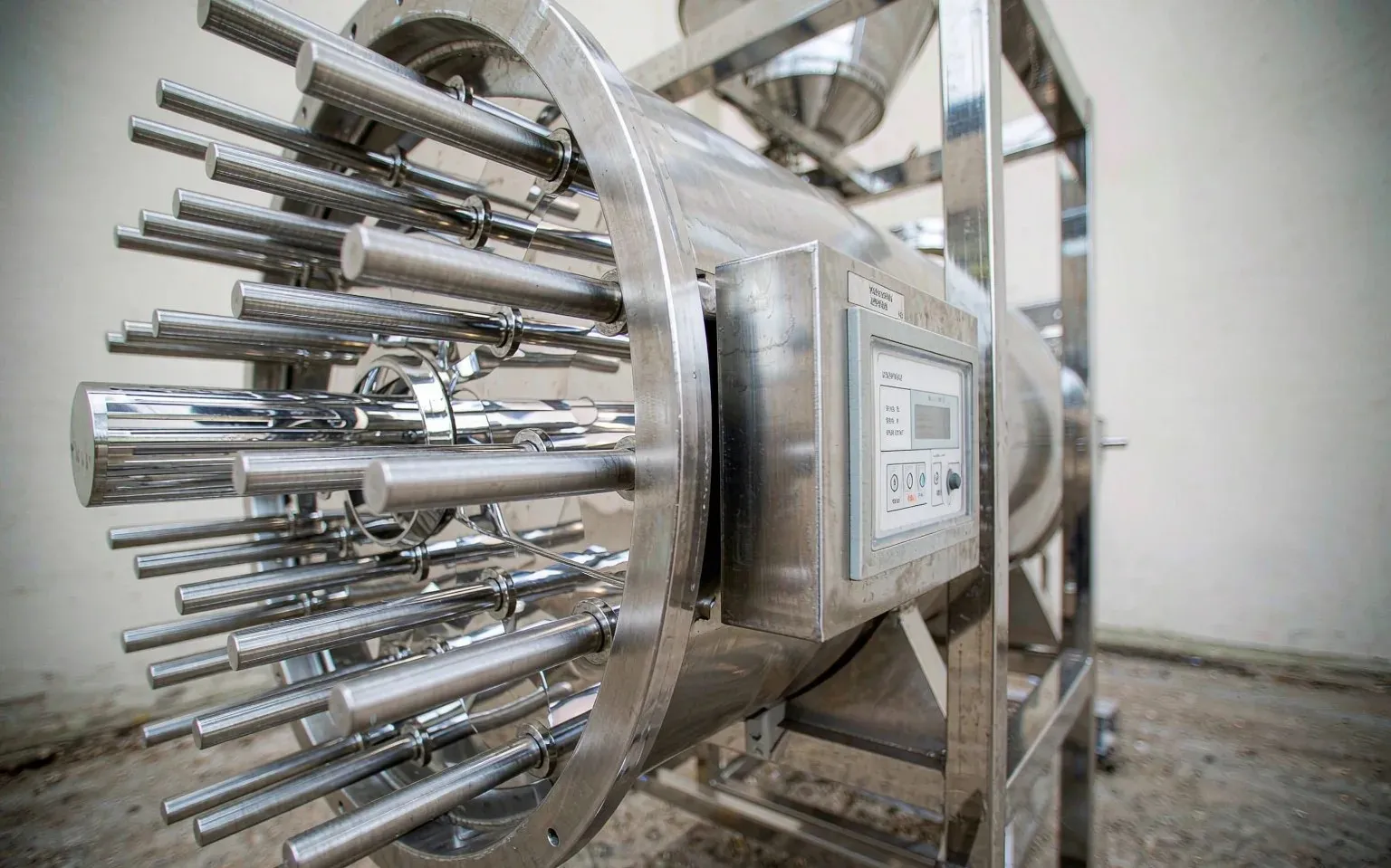
- Single disc vs. counter-rotating: a single-drive rotor-stator has one spinning and one fixed disc. Counter-rotating models spin both discs in opposite directions, reaching very high relative tip speeds (up to 240 m/s) for finer, stronger grinding.
- VFD control: pick a model with a variable-frequency drive so you can tune speed online without stopping, pinning the cut point precisely.
3. Material traits (moist, oily, or heat-sensitive)
- High-moisture or oily material: pin mills use centrifugal force through the disc, handling slightly damp, sticky, or oily powders better than traditional screen-equipped hammer mills.
- Heat-sensitive material: for cocoa, sugar, or heat-labile specialties, choose a unit with a large cooling jacket or a cryogenic (liquid-nitrogen) option that embrittles material before grinding.
4. Build material and maintenance
- Contact parts: choose carbon steel, sanitary stainless steel grades, or tungsten-carbide wear alloys per hygiene and corrosion needs.
- Cleanability: in food, pharma, or frequent-changeover plants, pick a design with a hinged full-access door or a cantilever mount for fast washdown.
5. Pin mill vs. hammer mill
| Aspect | Pin mill | Hammer mill |
|---|---|---|
| Best for | Fine to ultra-fine shear & impact grinding | Coarse bulk crushing, high volume, low precision |
| Energy per ton (fine) | Lower | Higher |
| Output uniformity | Even and consistent | Variable |
Recommended Pin Mill: Pinchuang Pin Mill
If you are specifying a pin mill for a new or upgraded line, Pinchuang Machinery’s Pin Mill is built for exactly the fineness, throughput, and material-flexibility needs described above. It ships with a variable-frequency drive, sanitary stainless-steel contact parts, and a hinged access door for fast cleaning — covering the food, pharma, and chemical duty cases in one platform.
Pinchuang can run a grinding trial with your actual material and recommend disc configuration, screen size, and drive power before you order. Send us your material and target particle size to get a tailored pin mill proposal and quote.
Frequently Asked Questions
What size reduction can a pin mill achieve?
Typically down to a D97 of 2.5–3 microns, with a d50 in the 40–80 micron range, depending on rotor speed, pin layout, and screen.
Can a pin mill handle oily or moist material?
Yes. The centrifugal, screen-light design handles slightly damp or oily powders better than a conventional hammer mill with a fine screen.
Is a pin mill suitable for food and pharma use?
Yes. With sanitary stainless-steel contact parts and a quick-access door, it meets hygiene and GMP cleaning needs.
Can you test the mill with my material?
Yes. Pinchuang runs grinding trials and recommends the optimal disc, screen, and drive configuration before order.